

Originally reported by Boaz Sobrado for Forbes. This article is our own editorial take on that coverage. To read the original reporting, visit: "A Fintech VC Just Led A $7.5M Bet On Private Aviation — Here's Why" on Forbes.com →
When a venture capital firm whose portfolio is built on payments and banking infrastructure leads a funding round in a private aviation software company, it's easy to wonder if they've strayed off course. But TTV Capital's decision to anchor Hamilton AI's $7.5 million seed round tells a story about where the real inefficiency in aviation actually lives, not in the jets, but in the transactions surrounding them.
What Hamilton AI Actually Does
Founded in 2024 by Wouter Witvoet and headquartered in San Francisco, Hamilton AI has built what it describes as a deterministic AI execution platform for private aviation. In practice, this means a single system that ingests the unstructured chaos of aviation operations — emails, WhatsApp messages, PDFs, maintenance records, operational documents — and converts it all into structured, auditable action without human intervention at every step.
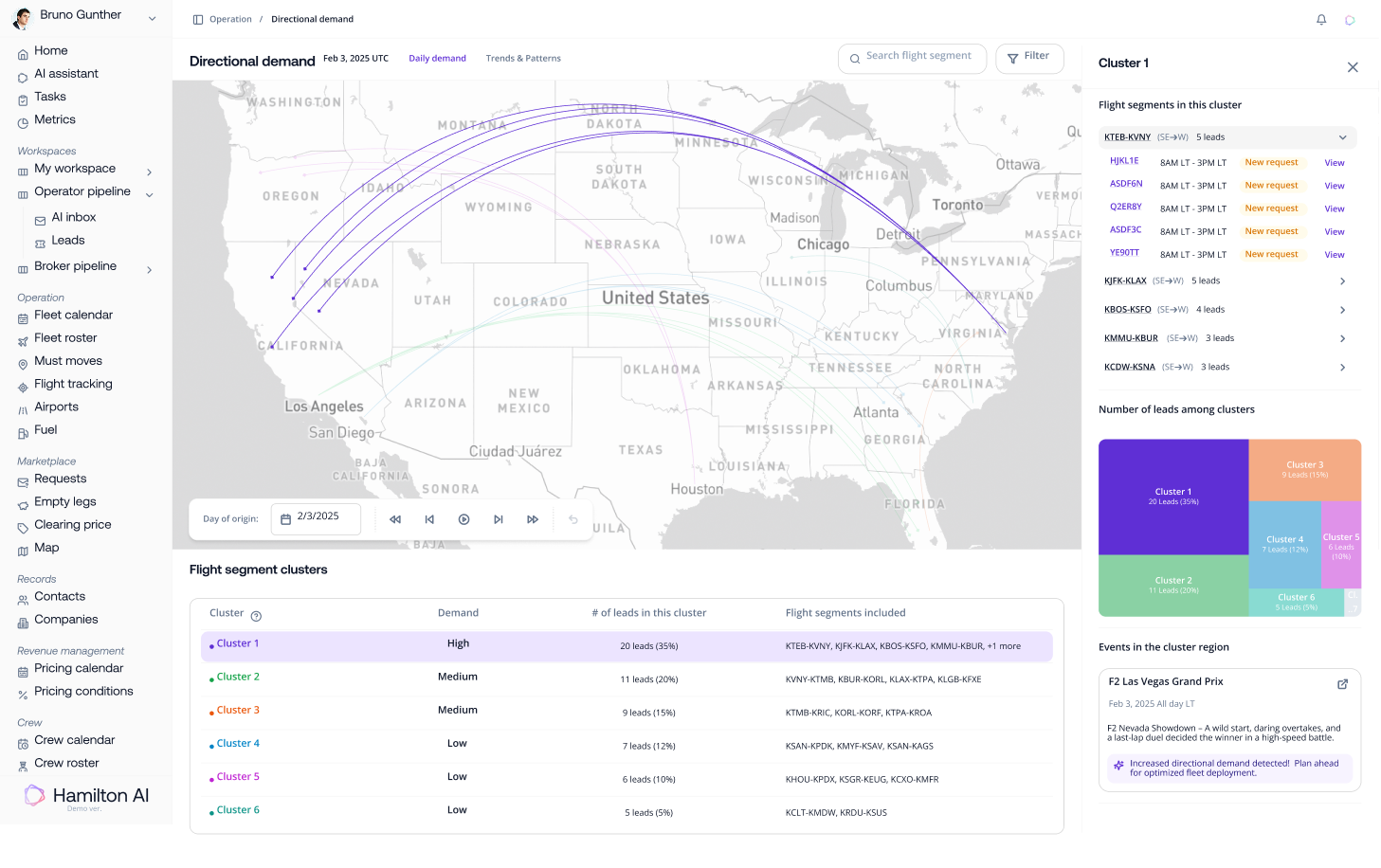
The platform handles the workflows that currently eat the most time: generating flight quotes, dynamically pricing trips against live supply and demand data, managing customer pipelines, optimising empty-leg routes, coordinating crew scheduling, and reconciling payments. Operators can move from initial request to confirmed booking with greater speed, fewer errors, and a fully traceable audit trail.
"Private aviation has the same fundamental problem: billions of dollars in activity running on manual processes."
— Wouter Witvoet, Founder & CEO, Hamilton AI
The results that early customers have reported are striking. One operator tripled its daily quote output — from roughly 400 quotes to over 1,200 — without hiring a single additional salesperson. Staff didn't disappear; they simply shifted away from manual data entry toward relationship management and deal closing.
Why a Fintech VC Leads This Round
TTV Capital manages over $750 million in assets and has spent more than two decades backing early-stage companies in payments, lending, banking infrastructure, and financial software. At first glance, private aviation looks like an odd fit. But Gardiner Garrard, TTV's co-founder and managing partner, has articulated the logic clearly: private aviation is fundamentally a financial services problem wearing an aviation costume.
Every flight booking involves high-value, time-sensitive transactions. Pricing must reflect real-time supply and demand. Payments need to be reconciled accurately and quickly. Compliance requirements add layers of documentation. The workflows that Hamilton AI automates are, at their core, the same workflows that fintech infrastructure has been modernising in banking and lending for the past decade; they just happen to involve aircraft rather than mortgages.
By integrating payment reconciliation directly into its platform, Hamilton AI adds measurable financial value to each transaction it processes. That embedded payment layer is precisely what TTV recognised as its area of expertise.
The Investors Behind the Round
TTV Capital led the seed round, with a strong supporting cast of early-stage specialists joining alongside them:
Bling Cambrian Ventures, FJ Labs, Weekend Fund, Mintaka Ventures, Ventures Correlation VC, HF0
The combination of a fintech-focused lead with generalist early-stage funds signals broad conviction, not just in the technology, but in the founding team's ability to execute in a complex, regulated market.
Who Is Wouter Witvoet?
Witvoet is a serial founder with a track record that lends genuine credibility to an ambitious vision. He previously scaled Secfi into the largest lending platform backed by private company equity, facilitating over $1 billion in transactions. He also played a key executive role in taking DeFi Technologies public on the NASDAQ, where it reached a market capitalisation of approximately $1.2 billion.
His consistent thread across these ventures is building execution infrastructure for markets characterised by high stakes, complex transactions, and historically poor tooling. Private aviation fits that profile precisely.
A $60 Billion Market Running on Spreadsheets
The private aviation market is valued at approximately $60 billion globally, yet a large share of operators still manage their business using a patchwork of legacy tools, some reports suggest operators routinely juggle over 25 separate systems to manage a single flight operation. Quoting, scheduling, dispatch, compliance, crew management, and invoicing all live in different places, connected by manual effort and email threads.
Hamilton AI's approach is to collapse that fragmentation into a single deterministic system. "Deterministic" is a deliberate choice of word: unlike generative AI systems that produce probabilistic outputs, Hamilton's platform operates with auditable logic, every action it takes can be traced and verified, which matters enormously in a regulated, safety-critical industry.
Early traction among U.S. commercial operators demonstrates that the market is ready. Key early customers including Baker Aviation, Craft Aviation, and Jetvia helped shape the product over Hamilton's first 18 months of operation, and the company plans to use this funding to expand its data pipelines, deepen its engineering capabilities, and accelerate product development.
Hamilton AI's raise is a signal worth paying attention to, not just for aviation professionals, but for anyone tracking where AI is creating genuine, measurable value in complex operational industries. The $60 billion question is no longer whether private aviation needs better software. It's who will own the execution layer when it finally gets it.
This editorial is based on reporting originally published in Forbes by Boaz Sobrado on 19 March 2026. For the full original article, including additional context and analysis:
Read the Original Forbes Article →